
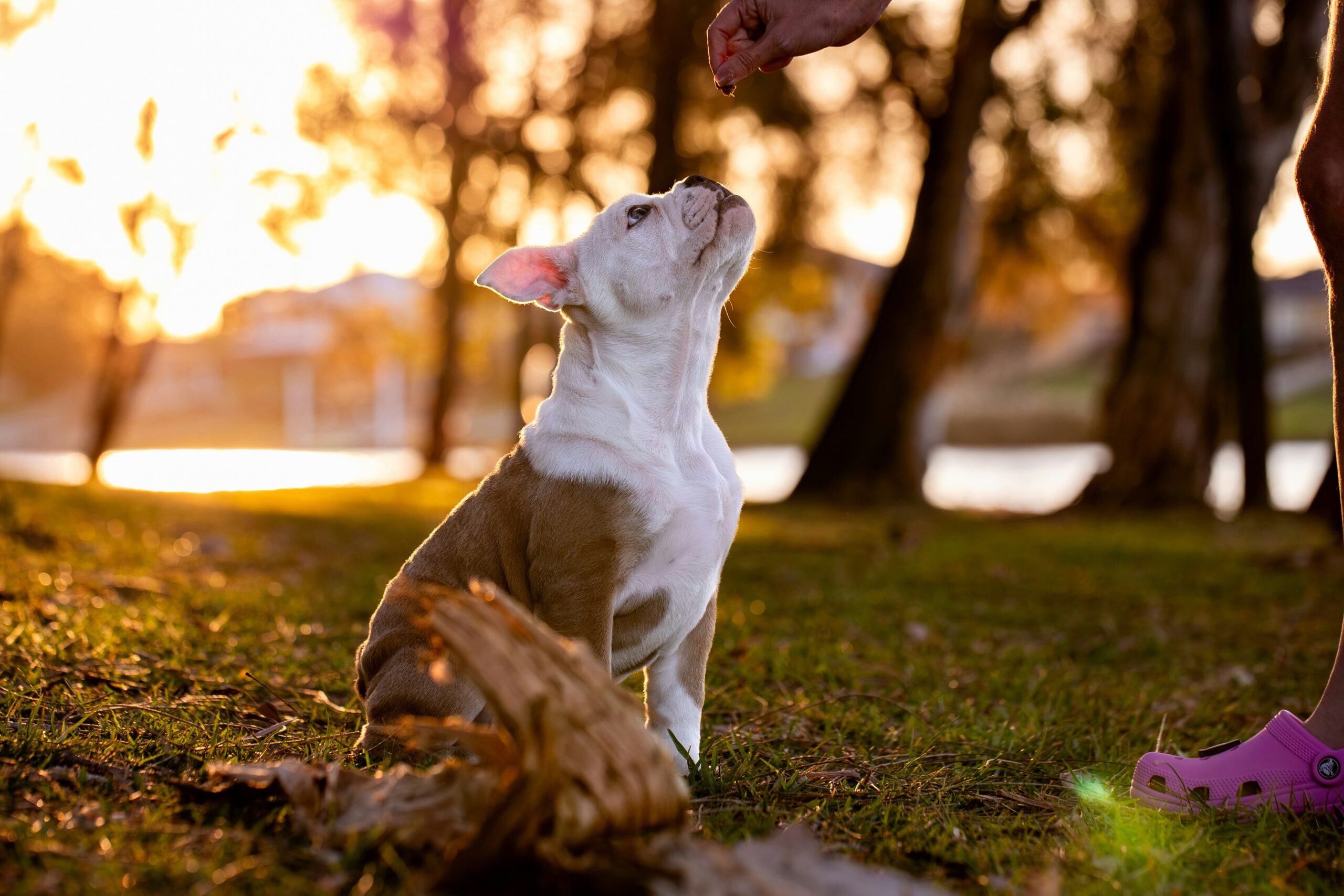

Positive reinforcement training focuses on teaching dogs through rewards, encouragement, and collaboration. In this guide, you’ll learn how to apply proven, force-free techniques to build real skills and change behavior. We’ll separate facts from common misconceptions and give you practical steps you can start using today.
What Is Positive Reinforcement Dog Training?
At its simplest, positive reinforcement dog training means you add something perceived as good (like a treat, praise, or a toy) immediately after your dog does a behavior you like. By rewarding the desired behavior, you make it more likely to happen again in the future.
Think of it as a paycheck. Your dog “works” by offering a “sit,” and you “pay” them with a reward.
To truly understand this, it helps to know the science. All training is based on “operant conditioning,” a concept with four parts, often called quadrants.
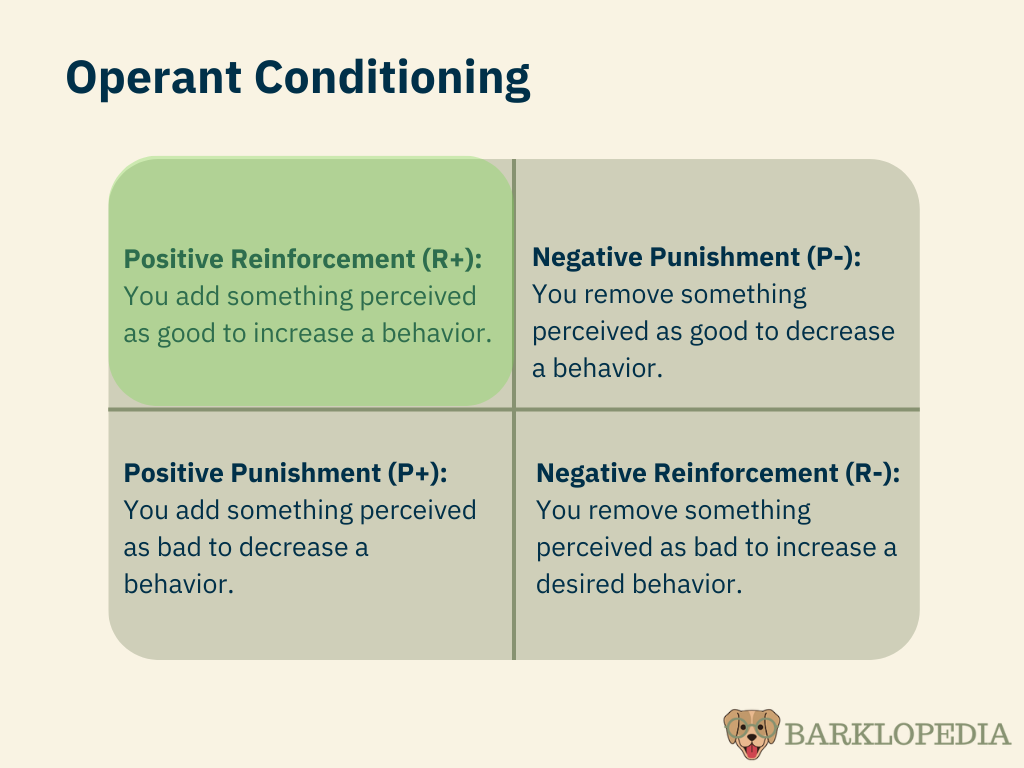
1. Positive Reinforcement (R+): This is our focus. You add something perceived as good to increase a behavior. (Example: You give your dog a treat when they sit).
2. Negative Punishment (P-): You remove something perceived as good to decrease a behavior. (Example: Your dog jumps for attention, so you turn away as a way to remove your attention).
3. Positive Punishment (P+): You add something perceived as bad to decrease a behavior. (Example: You use a shock collar, a prong collar, or yell at the dog when he engages in an undesirable behavior).
4. Negative Reinforcement (R-): You remove something perceived as bad to increase a desired behavior. (Example: A collar tightens when the dog pulls, and the pressure is only released when the dog stops pulling).
Force free training methods focus only on the first two quadrants: Positive Reinforcement (R+) and Negative Punishment (P-). This philosophy rejects the use of pain, fear, or intimidation (P+ and R-) to train a dog.
The Science of Good Behavior: How It Works
Positive reinforcement is not a guess; it’s a proven science. It relies on a simple, three part pattern that your dog learns very quickly.
This is often called the Antecedent Behavior Consequence contingency, also known as three-term contingency, or more simply, the ABC’s of dog training.
1. Antecedent:This is the cue or the signal that happens right before the behavior.
Example: You saying the cue word “Sit”
2. Behavior: This is the action your dog performs.
Example: Your dog’s rear end hits the floor.*
3. Consequence: This is what happens immediately after the behavior.
Example: Your dog gets a piece of chicken (Positive Reinforcement).
When the consequence is good, the dog’s brain makes a powerful connection: “When I hear ‘Sit’ and I put my butt on the floor, I get chicken!” This strengthens the behavior, making your dog *want* to sit when you ask.
The Benefits of Force Free Training
Opting for positive, force free methods is one of the best decisions you can make for your relationship with your dog.
- It Builds Trust: Aversive or “dominance” based training methods rely on your dog fearing the consequence. Positive training teaches your dog that you are the source of good things. This builds an unbreakable bond.
- It Encourages Learning: When a dog isn’t afraid of being wrong, they are more willing to try new things and offer behaviors. It creates a dog who thinks and problem solves.
- It Is Safe and Humane: There is no risk of physical injury from a prong collar or emotional trauma from an “alpha roll.” Force free training is kind and respectful.
- It Is More Effective Long Term: Aversive methods can suppress behavior, but they don’t change the underlying emotion. This can lead to anxiety, fear, or even aggression. Positive training works by addressing the underlying emotion, increasing motivation, and creating reliable, joyful obedience.
- It Is Fun! Training becomes a game you and your dog play together, not a battle of wills.
Positive Reinforcement Tools
You don’t need a lot of complicated gear to start. Success depends more on your timing and consistency than on expensive equipment.
- A Treat Pouch: This is essential. You need to deliver your reward *immediately* (within 1 to 2 seconds) for your dog to make the connection. Fumbling in your pocket is too slow.
- High Value Treats: Your dog’s everyday kibble might work in your living room, but it won’t work in a distracting park. You need high value rewards. These are special, “paycheck” treats like small pieces of cheese, hot dog, or plain cooked chicken.
- A Clicker (Optional but Recommended): A clicker is a small handheld device that makes a “click” sound. It is a powerful tool because it *marks* the exact moment your dog does the right thing. The click acts as a bridge that says, “YES, *that* was the behavior I wanted! A treat is coming.”
- Toys: For dogs who are more motivated by play than food, a favorite tug toy or ball can be a fantastic reward.
How to Use Basic Positive Reinforcement
Ready to try? Let’s start with some simple behaviors. Remember to keep sessions short (5 to 10 minutes) and always end them on a positive note.
Teaching a “Sit” (Using a Food Lure)
1. Take a high value treat and hold it in front of your dog’s nose.
2. Slowly move the treat up and *over* your dog’s head.
3. As their nose follows the treat up, their rear end will naturally go down.
4. The *second* their rear hits the floor, **click your clicker** (if using one) or use your verbal marker “Yes!” and give them the treat.
5. Repeat this until your dog reliably follows the hand motions.
6. After your dog reliably understands the motion, start saying the word “Sit” just *before* you do the hand motion.
7. Practice, practice, practice!
Solving Common Problems (The Force Free Way)
This is where the positive philosophy truly shines.
Problem: Your dog jumps on guests.
Positive Fix (P- and R+):
1. When your dog jumps, you and your guest become “trees.” You stand still, look at the ceiling, and remove any form of attention (this is Negative Punishment, or P-).
2. The *instant* your dog’s four paws are on the ground, say “Yes!” and reward them with a treat (this is Positive Reinforcement, or R+).
3. Your dog learns: “Jumping makes the humans stop giving me attention. Keeping my paws on the floor instead makes the humans give me treats.”
Aversive Fix: Kneeing the dog, yelling “Off,” using a shock collar. This (P+) can make the dog fear guests or even redirect onto you.
Problem: Your dog pulls on the leash.
Positive Fix (P- and R+):
1. The *moment* the leash gets tight, **stop walking**. Become a statue. Do not move forward (this is Negative Punishment, or P-).
2. Wait. Eventually, your dog will turn to look at you or the leash will loosen.
3. The *second* the leash is loose, say “Yes!” and start walking again. You can also reward with a treat delivered right at your side.
4. Your dog learns: “Pulling stops all the fun. Walking on a loose leash lets us keep going (and I may even earn a treat!).”
Aversive Fix: Using a choke or prong collar (P+ and R-). This causes potential discomfort/pain when the dog pulls and makes the discomfort/pain stop when the dog no longer pulls.
Common Myths About Positive Training
You may hear criticisms of this method. Let’s clear them up.
Myth 1: “It’s just bribery! You’re just feeding your dog treats.”
Fact: A bribe is given before the behavior to make it happen. A reward (or paycheck) is given *after* the behavior is completed. We are rewarding our dogs for a job well done. Over time, as the behavior becomes strong, you can fade the treats and use “real life rewards” like praise, petting, or a game of fetch.
Myth 2: “There is no discipline or consequences.”
Fact: This is a huge misconception. Positive trainers absolutely use consequences. Ignoring your dog when they jump (Negative Punishment) is a consequence. It just doesn’t involve pain or fear. This teaches your dog self control and how to make good choices.
Myth 3: “It won’t work for my stubborn/aggressive dog.”
Fact: This is dangerously false. For dogs with “stubborn” personalities or serious behavioral issues like aggression, positive training is the safest and most effective method. Aversive tools and punishment often make aggression worse by adding fear and anxiety. Positive training helps change the dog’s underlying emotion, building confidence and new, safer responses.
Advanced Positive Reinforcement Tips
Once your dog has mastered the basics in your living room, it’s time to make the behaviors reliable in the real world.
Fade the Food Lures: Stop using the treat to guide your dog’s motion. Use your empty hand to get your dog to sit using the upward hand signal. Then feed a treat from your other hand.
Introduce the Verbal Cue: Pronounce the verbal cue “sit” right before the hand signal. Then start gradually fading the hand signal.
Use an Intermittent Schedule: Once the behavior is reliably performed by your dog, you don’t need to pay them for *every* sit. You can move to an intermittent (or “gambling”) schedule. Reward them for the first sit, then the third, then the second. This actually makes the behavior stronger.
Add Distractions: Slowly add distractions. First, practice in your yard. Then on a quiet street. Then near a park. Go slow and set your dog up for success with high value rewards.
Seek a Professional: If you get stuck, find a certified professional dog trainer. Look for one who is certified by an organization like the CCPDT and who explicitly markets themselves as force free or positive reinforcement.
A Partnership Built on Trust
Positive reinforcement dog training is more than a set of rules. It is an evidence-based approach that sees your dog as a partner in the process, not an adversary to be dominated. By using science, patience, and compassion, you can build an incredible relationship and have the well behaved companion you’ve always wanted.
You are not just training your dog. You are learning their language, building their confidence, and strengthening your bond for a lifetime.
Frequently Asked Questions (FAQ)
Q: What is the difference between positive reinforcement and force free training?
A: Positive reinforcement is the specific action of adding a reward (like a treat or praise) to make a behavior happen more often. Force free is the overarching philosophy that guides the trainer. A force free trainer commits to not using pain, fear, or intimidation. Their primary tools are positive reinforcement (adding good things) and negative punishment (removing good things, like turning away when a dog jumps).
Q: How long does positive training take?
A: It depends on the dog, the behavior, and your consistency. You can teach a “sit” in a single session, but building a reliable recall in a distracting park can take months. The good news is that training is an ongoing, fun part of your life, not a chore with a deadline.
Q: Can I train an old dog with these methods?
A: Absolutely! The idea that you can’t teach an old dog new tricks is completely false. Older dogs may learn at a different pace, but they are just as capable of learning through positive reinforcement. In fact, it’s a wonderful way to build their confidence and keep their minds active.
Q: My dog only listens when I have food. What should I do?
A: This is a common hurdle! It usually means you are still in the “lure” phase or your dog sees the treat as a bribe. Make sure you are fading the lure (hide the treat in your hand or pouch) and using a clear marker (like “Yes!” or a click). Also, be sure to “proof” the behavior by practicing in new places and slowly adding distractions, rewarding with high value treats.
Q: My dog is leash reactive and nervous. Will positive training and behavior modification help?
A: Absolutely. In fact, it is the safest and most effective way to help a nervous or reactive dog. This is a very personal topic for me. My own dog is nervous and used to be extremely leash reactive. Seeing other dogs, bikes, or even new people in the street was very stressful for him.
Instead of “correcting” or punishing him, which would only make his fear worse, I used desensitization and counter conditioning. We started with very gradual exposures starting at a safe distance where he could see a “trigger” (like a bike) but not react. This helped “desensitize” him to the trigger. The moment he saw the bike, I would say “Yes!” and give him a very high value treat.
He quickly learned that bikes make chicken appear. His brain’s emotional response began to change from “Oh no, a bike!” to “Where is my chicken?”
Today, when he sees a trigger, he doesn’t bark or lunge. He immediately looks at me, ready for his reward. We changed his fear into confidence and built an incredible level of trust.
Q: What if my dog isn’t motivated by food?
A: First, make sure you are using high value treats (like chicken, cheese, or hot dogs) and not just dry kibble, especially in new places. But if your dog truly is not a foodie, don’t worry! A “reinforcer” is simply anything your dog loves.
Does your dog love toys? You can reward a “sit” with a quick game of tug or a throw of their favorite ball. Does your dog love sniffing? On a walk, you can reward a moment of loose leash walking by saying “Go sniff!” and letting them explore an interesting spot.
Does your dog love praise? A happy, “Good dog!” or a nice scratch on the chest can work wonders for many dogs.
The key is to find what your dog will work for and use that as your payment.
Q: My dog doesn’t seem to care about food, toys, praise or any other reinforcers. How can I fix that?
If your dog appears disinterested in any type of reinforcers, consider that he may be too anxious, fearful or distracted by certain stimuli in his environment.
In these cases, it helps to pinpoint the source of his fear so as to implement management and a behavior modification protocol such as desensitization and counterconditioning to change your dog’s emotional response to his triggers.
Once your dog is more relaxed in presence of the triggers, his brain will be in a better learning state. However, consider that in some cases, the environment itself may be too stimulating or unpredictable, rather than a single trigger.
In these cases, it is best to seek professional help. Many anxious dogs need a full behavior evaluation and sometimes medication.
Furthermore, underlying medical conditions such as nausea, GI issues, dental disease, metabolic disease, and other medical conditions can reduce interest in food and play.
Q: What tools should I avoid in force free training?
A: A force free philosophy means we avoid any tool that is *designed* to work by causing pain, fear, or discomfort. This includes:
Prong collars
Choke chains (or slip leads)
Shock collars (also called e collars or remote collars)
These tools are based on positive punishment (adding a painful shock or “correction”) or negative reinforcement (the pain only stops when the dog complies).
Positive training focuses on “want to” tools like comfortable harnesses, flat collars, long lines, and treat pouches.
Q: Is positive training the same as being permissive or having no rules?
A: Not at all. This is one of the biggest myths in dog training. Positive training is **not** permissive. It is about setting very clear boundaries and having consistent consequences.
The key difference is the *type* of consequence. In dominance based training, the consequence for a bad choice is often positive punishment** (P+) where something unpleasant is added to decrease the likelihood of the undesirable behavior.
In positive training, the consequence for a bad choice is often **negative punishment** (P-), where something desirable is removed to decrease the likelihood of the behavior.
Example: A dog jumps on you for attention. Instead of yelling or kneeing the dog (P+), you turn your back and walk away (P-). The dog learns, “Jumping causes my human to stop giving me attention.”
The dog can then be also taught through positive reinforcement (R+) the pleasant consequence that “sitting politely makes my human stay and pet me or even give me a treat.” The addition of the petting or treats makes the sitting behavior strengthen and become more likely to repeat in the future.
This approach teaches dogs how to make good choices and have self control based on the consequences of their actions.
Q: Why do some trainers still talk about being the ‘alpha’ or ‘dominant’?
A: This idea comes from outdated and “debunked” science from the 1970s. The theory was based on flawed observations of captive, unrelated wolves who were forced to live together. Modern science, and even the original researcher, has since rejected this “alpha” theory.
Your dog knows you are not a dog. They are not trying to “dominate” your household. They are simply trying to do what works. If jumping on the counter gets them a sandwich, they’ll keep doing it!
**Dominance theory** promotes using force and intimidation, which can break your dog’s trust and often leads to anxiety or aggression. **Positive reinforcement** builds a partnership based on clear communication and mutual respect.
Q: How long does positive training take?
A: It depends on the dog, the behavior, and your consistency. You can teach a new “sit” in a single 5 minute session. Changing a deep seated emotional response, like fear or reactivity, will take longer.
The good news is that positive training is not a chore with a deadline. It is a new, fun, and engaging way to communicate with your dog. You will see small victories every single day, and that is what builds the amazing bond you’re looking for.
Q: My dog only listens when I have food. What should I do?
A: This is a common and fixable problem! It usually means the treat has become a **bribe** (shown *before* the behavior) instead of a **reward** (given *after* the behavior).
1. Use a Marker: Use a clicker or a marker word like “Yes!” the *instant* your dog performs the behavior. This marks the moment, and the treat comes after. The “Yes!” becomes the signal that they did it right.
2. Hide the Reward: After several reps using the food lure in your hand, start keeping the treat in your pouch or pocket, not in your hand. Basically, keep the same hand motion, but without a treat in your fingers. After your dog sits, mark, then reward by taking the treat from your pocket or pouch. This teaches the dog that sitting still earns a reward, but the reward is not shown beforehand.
3. Still struggling? Do several trials with the food lure clearly in your hand and then in the midst of them, do one quick one without the food being so readily visible.
4. Vary the reward. Once your dog reliably sits, you can shift from a continuous schedule (a treat given every time the dog performs well) to an “intermittent schedule” (a treat is given only sometimes), but don’t give up rewards completely. Instead, try to sometimes give a treat, sometimes praise and sometimes a toy. This builds excitement, just like a slot machine, which will keep your dog happy and motivated. A win-win situation for all!
References
Guilherme-Fernandes J, Olsson IAS, Vieira de Castro AC. Do aversive-based training 756 methods actually compromise dog welfare?: A literature review. Appl Anim Behav Sci. 2017; 757 196, 1-12
Vieira de Castro AC, Fuchs D, Pastur S, et al. Does training method matter?: Evidence for the negative impact of aversive-based methods on companion dog welfare. bioRxiv 2019:1-34.